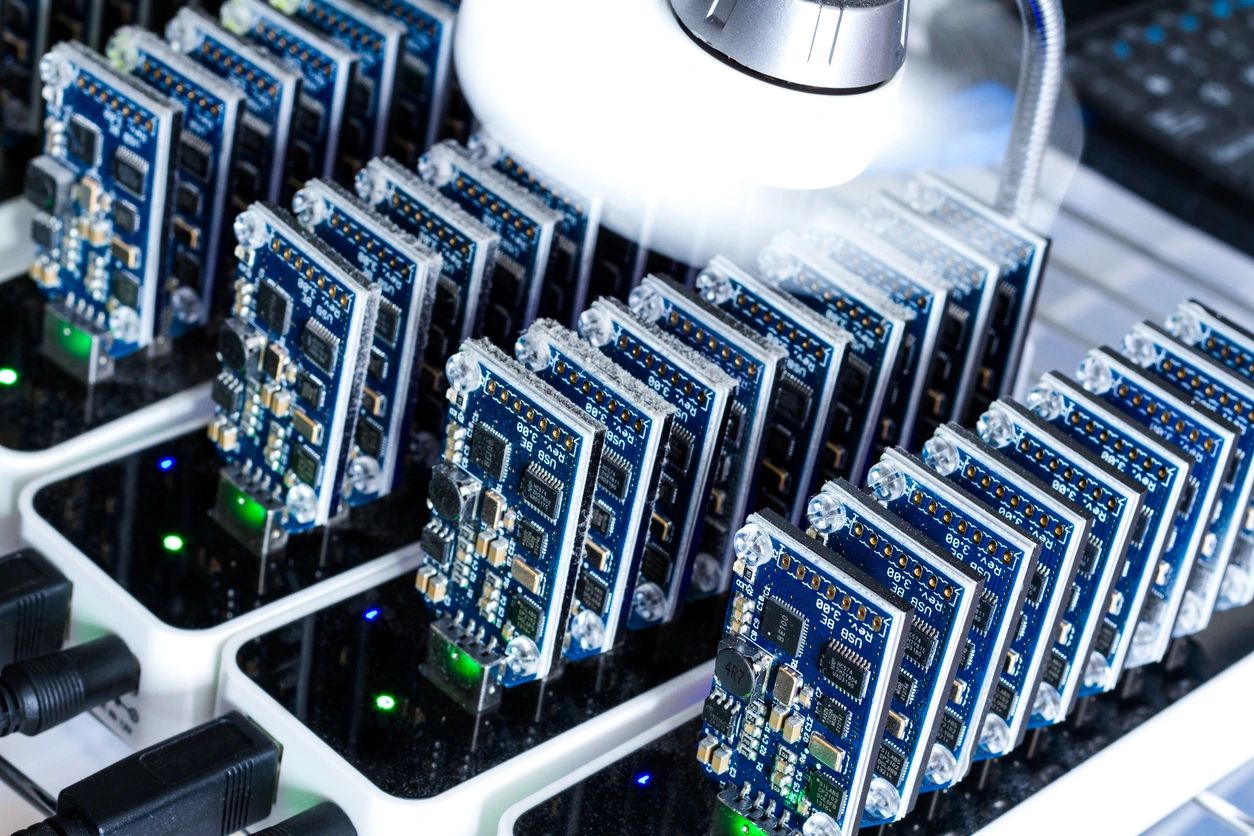
Printed circuit boards (PCBs) are essential in electronic devices, providing both physical support and electrical connections for components like processors, memory, and sensors. During manufacturing, proper testing is crucial to ensure PCBs function correctly and meet required specifications. Several testing methods exist, each with unique benefits and limitations.
In-Circuit Testing (ICT)
One common PCB testing method is in-circuit testing (ICT). This process involves connecting a specialized testing machine to the PCB to check each component and the overall board function. ICT is fast, can be automated, and is ideal for high-volume testing. However, it has limitations, such as difficulty detecting defects related to soldering quality.
Bed-of-Nails and Spring Probes
ICT can be performed using a Bed-of-Nails fixture, a tool designed for simple board-level testing. This setup often includes spring probes, which are specialized electrical connectors that make temporary contact with a PCB’s test points. These probes consist of a spring-loaded metal pin mounted on a carrier, which is then attached to a probe head compatible with the ICT machine.
When the probe head presses onto the PCB, the spring probes establish an electrical connection, allowing for efficient testing. Spring probes are widely used in ICT because they are cost-effective, easy to reconfigure, and adaptable for different PCB designs.

Functional Testing of PCBs
Functional testing checks how a PCB works by simulating real-world use. In simple terms, the test confirms that the board performs as intended when powered and operating.
Unlike in-circuit testing (ICT), functional testing takes more time. However, it provides a deeper view of overall PCB performance and behavior.
What Is Functional Testing?
During functional testing, engineers connect the PCB to a computer or test equipment. Then, they run a defined set of tests to confirm correct operation.
As a result, teams can verify performance before the PCB moves to production or deployment.
Key Steps in Functional Testing
Setting Up the Test Environment
First, technicians connect the PCB to test equipment or a computer.
Next, they configure the required hardware and software.
Writing Test Cases
After setup, engineers define test scenarios. These tests check key tasks, operating limits, and component behavior.
In addition, teams may include tests for specific use cases or conditions.
Running the Tests
Then, engineers run the test cases manually or through automation.
During testing, they monitor behavior and record results.
Analyzing the Results
Finally, teams review the results to determine pass or fail status.
If issues appear, engineers identify defects and apply corrections.
Types of Functionality Tested
Functional testing covers different performance areas. Depending on the design, tests may include the following.
Basic Electrical Functions
These tests confirm power control, data flow, and connectivity.
For example, CTS custom test fixtures use spring probes or connectors for continuity checks.
Component-Level Functions
These tests confirm that LEDs, buttons, sensors, and displays work properly.
To support this, CTS engineers identify critical components and choose the best test method.
System-Level Functions
System-level tests evaluate complex operations, such as running an operating system or controlling devices.
In these cases, CTS fixtures support customer-defined I/O but do not handle programming.
Environmental Testing
Environmental testing simulates temperature, humidity, or vibration.
When needed, CTS fixtures integrate RF boxes, lights, motors, and other components.
Reliability Testing
Reliability testing runs repeated cycles to confirm long-term durability.
Because of this, CTS fixtures support hundreds of thousands to millions of cycles with replaceable wear parts.
Ensuring Reliable PCB Testing
A clear and consistent testing process improves PCB quality. Therefore, functional testing helps reduce defects and improve product reliability.
At CTS, we design custom mechanical test fixtures for both ICT and functional testing. As a result, our solutions improve accuracy, speed testing, and ensure PCBs meet required specifications.