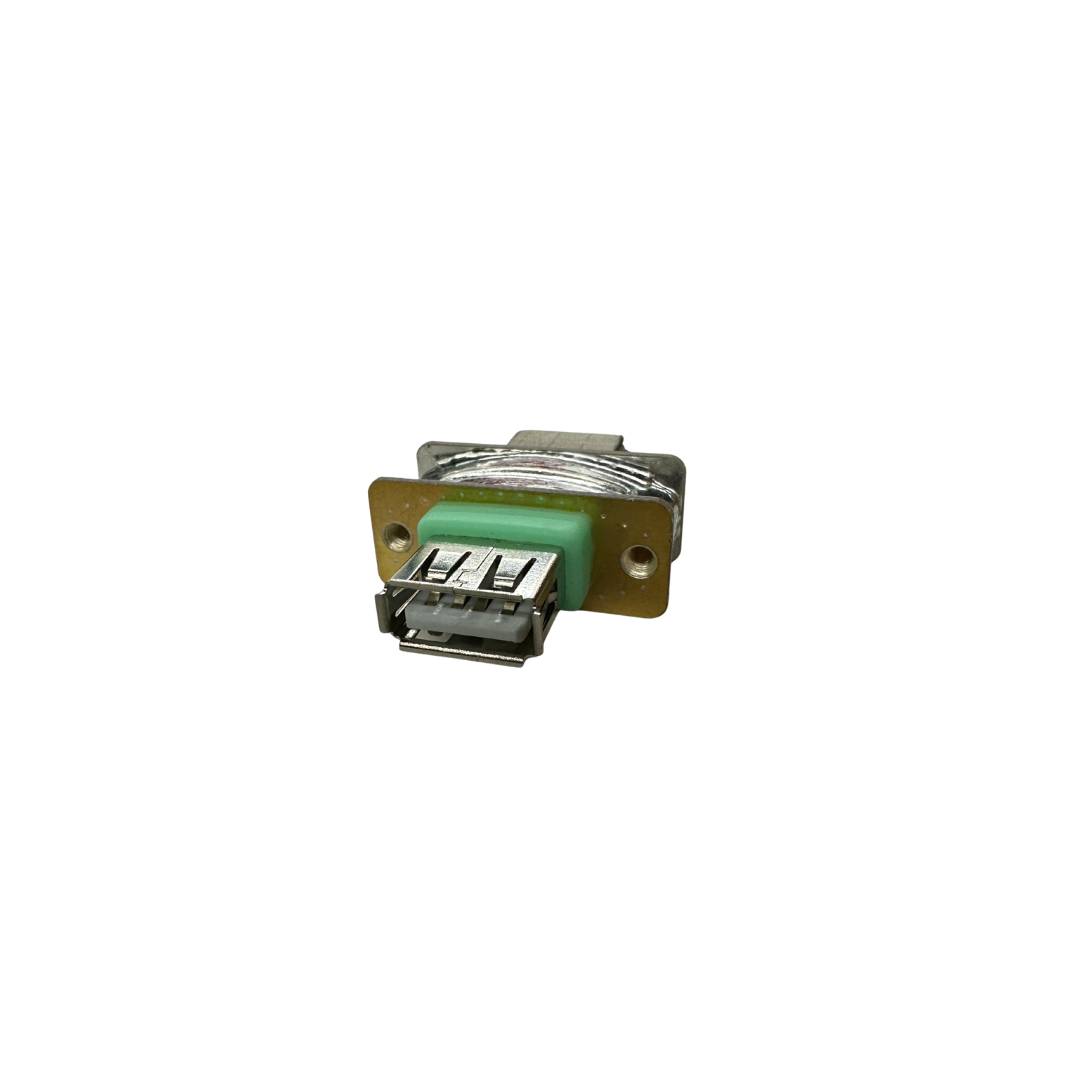
Description
USB 2.0 Filter Connector
The USB 2.0 Filter Connector is designed to deliver secure USB data transfer while providing strong EMI and RFI suppression for interference-sensitive electronic systems. From the first connection, this filtered USB interface helps maintain stable communication in environments where electromagnetic noise can degrade performance.
Engineers commonly integrate this connector into RF shield boxes, industrial electronics, and controlled test environments. Because USB interfaces often link sensitive devices to external equipment, connector-level filtering plays a key role in protecting signal integrity and system reliability.
EMI/RFI-Filtered USB 2.0 Interface for RF Applications
This EMI/RFI-filtered USB interface supports a typical data rate of up to 480 Mbps, making it suitable for control, monitoring, and data acquisition applications. In addition, it operates at 5 V and 500 mA, with a maximum current capacity of up to 5 Amps, ensuring dependable power delivery in demanding environments.
As a result, engineers can rely on consistent USB performance even in RF test setups where noise and interference are common challenges.
Shielding Performance for Interference-Sensitive Systems
The connector delivers strong shielding effectiveness across a wide frequency range. It provides greater than 60 dB attenuation from 0.5 to 2 GHz, greater than 70 dB from 2 to 3 GHz, and greater than 70 dB from 3 to 6 GHz. Therefore, it effectively blocks unwanted electromagnetic interference that can compromise sensitive USB communications.
Because RF shielded enclosures often combine power, data, and RF signals in close proximity, this level of suppression is essential for maintaining repeatable and accurate system operation.
Designed for RF Shield Boxes and Industrial Use
The rugged construction supports long-term use in laboratory, validation, and production environments. Engineers can integrate this filtered USB connector into precision-machined I/O panels and RF shield boxes without sacrificing durability or performance.
Moreover, the design helps prevent noise from entering or leaving the enclosure, supporting both compliance and reliable system behavior.